
January 30, 2026
Insurance isn't just about reimbursing you after something goes wrong - it's about ensuring your life keeps moving when disruptions happen. Whether it's a missed loan payment, a delayed flight, or an unexpected expense, waiting for claims to process can leave you in a tough spot. Embedded insurance changes the game by offering instant protection built into everyday transactions like booking a flight, signing a lease, or applying for a loan. This approach eliminates financial gaps, providing immediate support when you need it most.
Key Points:
Embedded insurance isn't just a convenience - it's a smarter way to stay financially secure without the wait.

Life doesn’t pause when challenges arise. Bills still need to be paid, and emergencies don’t wait. The gap between unexpected events and traditional insurance payouts can turn what might have been a minor inconvenience into a major crisis. This plays out in everyday situations like missed loan payments, rental evictions, and travel disruptions.
When life throws a curveball, even routine loan payments can be derailed. Financial shocks hit 60% of households, with a typical cost of $2,000 - roughly half a month’s income [8]. Whether it’s a surprise car repair, a medical bill, or a sudden job loss, these events can disrupt payments. And traditional insurance isn’t built to provide immediate help.
Here’s the reality: 37% of adults can’t cover a $400 emergency expense with cash or its equivalent, and 13% say they wouldn’t be able to pay it at all [11]. Missing even one payment can trigger a chain reaction: 42% of those who miss a payment face another late fee the next month, and 14% of non-retired adults have had to borrow from or dip into their retirement savings as a result [11].
The Aspen Institute highlights the issue clearly:
"When public and private benefits - such as unemployment insurance and paid sick leave - are not accessible and not designed or delivered in a timely manner to effectively support families in weathering financial shocks, families suffer."
For the 35% of U.S. households that rent, housing costs are often the largest monthly expense. With the median rent hitting $1,200 in 2024 and rising about 10% annually since 2022, even a short-term income loss can jeopardize housing stability [7]. By May 2025, 21% of renters reported falling behind on rent [7]. Once rent is overdue, the situation can spiral quickly - median arrears climb to $3,200, compounded by late fees [10]. Alarmingly, 42% of renters who pay a late fee one month will face another the next, and 30% remain behind five months later [10].
Evictions also come at a cost to landlords, often equaling 2–3 months of rent [12]. While some tenants may be unable to recover, 15% of evicted renters could have caught up with temporary financial support or forbearance [12]. As B. Heath Witzen from the CFPB explains:
"Falling behind on rent payments is a potential indicator of economic stress and a possible precursor to more severe outcomes such as having to move or being evicted."
In fact, 2% of all renters - representing 14% of renters who moved in 2024 - relocated due to an eviction or the threat of one [7].
Travel disruptions can lead to sudden, unplanned expenses, and traditional travel insurance often falls short in providing immediate support. When flights are canceled or trips are interrupted, travelers face urgent costs like rebooking fees, extra hotel nights, meals, and transportation. Most travel insurance policies operate on a reimbursement model, meaning travelers must pay out of pocket and wait for claims to be processed [13]. Coverage for delays or baggage issues typically kicks in only after 12 to 24 hours, leaving travelers to fend for themselves during the crucial early hours [13].
Additionally, standard travel insurance often has gaps in coverage or requires expensive add-ons like Cancel For Any Reason (CFAR), which usually reimburses just 50%–75% of nonrefundable costs [13]. For instance, a basic travel insurance plan for a $1,500 trip might cost $59, but it may not provide the immediate help needed during an emergency [13]. Natural disasters and severe weather - issues that financially impacted 21% of adults - are common causes of travel disruptions [7]. Combined with confusing policy options and slow claims processes [13], these situations can quickly leave travelers under financial pressure with little immediate relief.
Embedded insurance offers a safety net that quietly operates in the background, stepping in when traditional claims systems fall short. It’s designed to shield consumers from the financial turmoil that can arise during unexpected events.
Embedded insurance weaves protection directly into the purchase process. It’s coverage offered at the exact moment someone applies for a loan, signs a lease, or books a trip. Thanks to modern APIs and no-code tools, businesses can connect with insurance providers without building their own infrastructure. By spreading risk across a larger pool of customers, this approach often leads to lower premiums compared to standalone policies [5][6].
The potential here is massive. The global embedded insurance market is estimated to be a $3 trillion opportunity, fueled by digital platforms that handled $36 trillion in global payments in 2020 [5]. Millennials and Gen Z, who prefer digital-first experiences, are driving adoption of these solutions.
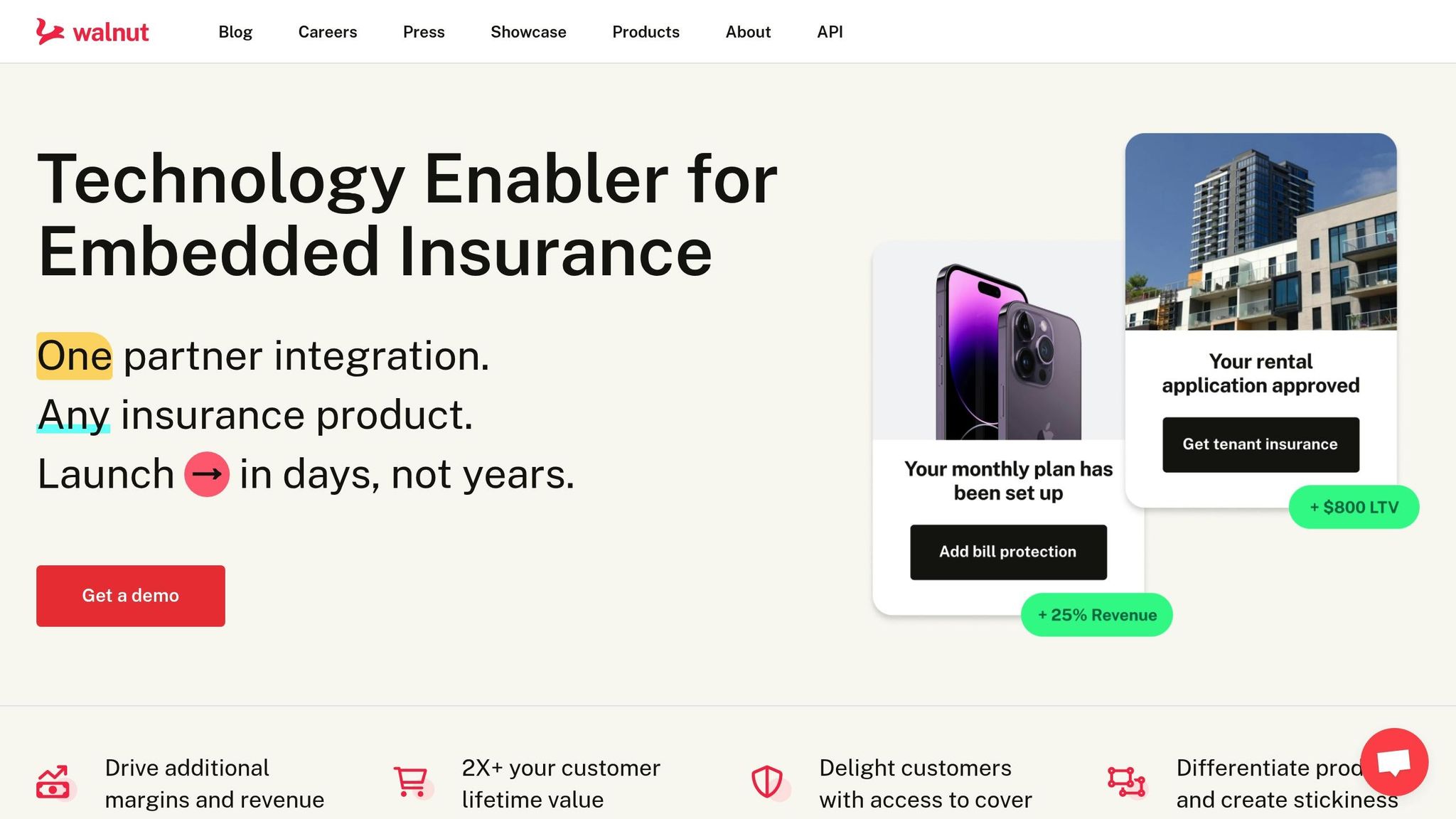
Walnut simplifies embedded insurance with its "One partner. One API." model, enabling businesses to offer insurance products without needing prior expertise. The platform connects businesses to over 14 insurance carriers and takes care of licensing, compliance, and customer support across various channels. This streamlined approach allows companies to launch insurance solutions quickly and efficiently.
Walnut offers three integration options for businesses:
A standout example is Neo Financial, a Canadian neo-bank with over 1 million customers, which partnered with Walnut in 2022. Neo Financial incorporated credit card insurance options - like extended warranty, purchase protection, mobile phone protection, and life insurance - into its app. Andrew Chau, Neo Financial’s Co-founder and CEO, shared:
"We're excited to partner with Walnut, bringing insurance into the digital age and creating greater access to protection for all Canadians. We've been impressed with how their infrastructure has been able to support us in growing our product offering."
This partnership allowed Neo Financial to expand its offerings while maintaining its unique brand experience. Walnut’s no-code solutions can launch programs in under 24 hours, while API integrations have the potential to significantly increase customer lifetime value [14].
Walnut tailors its insurance programs to fit specific needs, ensuring protection is available when it’s most critical. For example:
What makes these programs effective is their seamless integration into key moments. A renter can add tenant insurance during the lease process, a borrower can opt for payment protection with a single click, and a traveler can secure trip coverage right at checkout. This approach ensures coverage is immediate, minimizing disruptions and keeping financial stability intact.
Embedded insurance doesn’t just fill financial gaps - it also boosts customer engagement and streamlines business operations, offering real advantages to both consumers and companies.
By integrating insurance directly into the purchase process, companies strengthen customer loyalty. Whether someone is signing a lease, booking a flight, or applying for a loan, the seamless inclusion of protection makes customers feel cared for. Instead of being just another service provider, the brand becomes a trusted partner anticipating their needs.
Take this example: a major bank saw 70,000 new account openings in just one year after teaming up with Chubb to offer embedded insurance. Similarly, a global credit card company in Asia reduced marketing costs by 56% and slashed cost-per-acquisition by 65% [17]. These numbers highlight how offering protection at the right moment builds trust and reduces the need for costly marketing campaigns. As a Chubb expert put it:
"When your customers see innovative service offerings during their purchase journey with you, they're more likely to keep coming back." - Chubb
The impact is clear: 74% of banking and fintech executives believe embedded insurance fosters trust [16]. Customers appreciate the convenience of built-in protection, making them less likely to switch providers. This loyalty not only benefits businesses but also ensures financial security for policyholders.
Embedded insurance activates coverage immediately, providing peace of mind and financial stability. For instance, Nubank in Brazil introduced "Nubank Parcela Segura" in 2023 in partnership with Chubb. This program allows customers with personal loans to embed protection, ensuring their loan payments remain current during unforeseen events. Impressively, over 50% of Nubank’s life insurance policyholders said it was their first experience with such coverage [16].
In the Philippines, GCash partnered with Chubb to launch "GInsure Bill Protect" in 2023. For less than 1% of the bill payment amount, customers receive a lump sum benefit equal to 36 times their enrolled bill payments in cases of accidental death or permanent disability [16]. These examples show how embedded insurance provides instant, accessible protection, keeping customers financially secure during challenging times.
Traditional insurance can be slow to adapt, but embedded models offer the speed businesses need to thrive. The global embedded insurance market is projected to be worth $3 trillion, with property and casualty insurance alone expected to hit $70 billion in the U.S. and $700 billion globally by 2030 [5][1]. If just 20% of the U.S. personal auto insurance market shifts to embedded channels, about $50 billion in premiums could move away from traditional methods [1].
API-driven platforms make it possible for companies to launch insurance programs almost instantly. These programs not only create new revenue streams through direct sales and revenue-sharing models but also significantly boost customer lifetime value - often doubling it [14]. Walnut, for example, offers no-code solutions that enable businesses to launch programs in less than 24 hours. A representative from Walnut Insurance summed it up well:
"Embedded insurance is no longer just a nice extra - it's a must-have for companies looking to add real value for their customers." - Walnut Insurance
The shift is undeniable: 81% of financial executives believe embedded insurance will soon be essential for businesses [16]. By incorporating protection into their core offerings, companies not only gain a competitive edge but also generate additional revenue without increasing operational complexities.
Insurance should act as a safeguard before disruptions occur - not as a remedy afterward. By integrating coverage into everyday transactions, insurance shifts from being a reactive solution to a proactive safety net, ensuring stability in areas like loans, rent, and travel when challenges arise.
The global embedded insurance market is massive, valued at an impressive $3 trillion [5]. In the U.S. alone, property and casualty premiums are projected to surpass $70 billion by 2030 [18][19]. Additionally, by 2028, over 30% of all insurance transactions are expected to flow through embedded channels [19].
This approach helps close the protection gap, making insurance more accessible and inclusive [5][18]. By embedding coverage at key transaction points, companies eliminate the need for separate insurance purchases. The result? Financial gaps are avoided, trust is strengthened, customer churn decreases, and businesses unlock new revenue opportunities - all without adding unnecessary complexity.
This forward-thinking model not only prevents financial disruptions but also transforms how businesses strategize and operate.
For leaders, embedding insurance into core offerings is no longer optional - it’s essential. Success lies in focusing on specific customer needs, adopting modern technology, and creating seamless integration experiences:
It’s not just about direct revenue from insurance. The ripple effects - like reducing customer churn, increasing loyalty, and lowering acquisition costs - are just as powerful [3]. As BCG aptly notes:
"Insurers will have to acknowledge that future success will come only by helping companies become better insurance providers than they will ever be."
The message is clear: businesses that embed continuity into their offerings won’t just protect customers - they’ll foster loyalty, drive growth, and redefine the future of insurance.
Embedded insurance weaves coverage directly into everyday purchases, making it straightforward and accessible exactly when you need it. Instead of buying insurance separately, it’s seamlessly offered as part of transactions like purchasing a car, booking a vacation, or renting a home. This streamlined approach cuts out extra steps, reducing both paperwork and hassle.
The idea is to deliver tailored protection right at the moment of purchase, offering peace of mind without disrupting the process. For instance, when booking a flight, you might see travel insurance automatically included or as an easy add-on during checkout. Thanks to digital technology, embedded insurance simplifies access to coverage, allowing life to move forward without unnecessary interruptions.
Embedded insurance shifts the focus from simply reimbursing losses to ensuring continuity in challenging times. Instead of waiting for a payout after an incident, this type of coverage is seamlessly integrated into financial products such as loans, credit agreements, or rental contracts. The goal? To help individuals meet their obligations even when life throws a curveball. For instance, loan protection programs can step in to pause or cancel payments if someone loses their job or becomes disabled. This not only prevents missed payments but also safeguards credit scores.
By embedding insurance into everyday transactions, protection becomes more accessible and effortless. It allows people to navigate disruptions like travel delays, home repairs, or medical emergencies without juggling multiple policies. This built-in coverage eases financial stress, keeps daily life running smoothly, and supports long-term stability for households.
Embedded insurance brings a range of benefits to businesses, starting with a smoother customer experience. By integrating real-time coverage directly at the point of purchase - whether it's during checkout on an e-commerce site or while booking a trip - customers can secure protection without jumping through extra hoops. This convenience not only simplifies the process but also builds trust and loyalty, as people value hassle-free solutions.
For companies, this approach unlocks fresh revenue streams. By embedding insurance into platforms like travel bookings, loan services, or online marketplaces, businesses can offer services that feel natural and relevant to their customers' needs. It’s also a way to stand out in crowded markets by delivering personalized, value-driven options that match modern consumer expectations. Plus, the automation and real-time management of policies help cut down on administrative overhead, making operations more efficient and speeding up the rollout of new offerings.
In short, embedded insurance strengthens customer connections, boosts financial resilience, and positions businesses to thrive in today’s fast-paced, digital-first world.